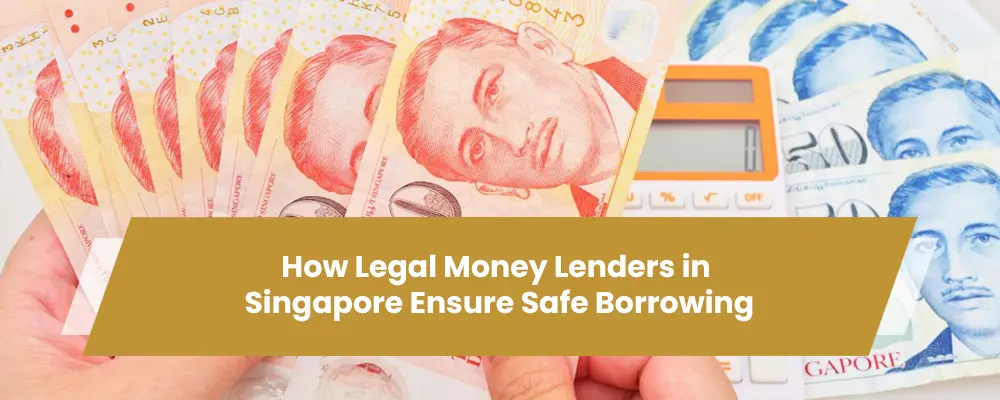
Money troubles don’t wait for a convenient time, and neither do the people who try to take advantage of them. If you’ve ever searched for a quick loan in Singapore, you’ve probably noticed two very different worlds: one regulated, transparent, and boring in the best way, and one built on intimidation. Legal money lenders in Singapore sit firmly in the first camp, and the protections built into that system are the entire reason they’re worth choosing over anything else.
Here’s what actually keeps borrowers safe when they go the legal route, and how to tell the real thing from a scam wearing a suit.
Table of Contents
ToggleWhat Makes a Money Lender “Legal” in Singapore?
- A legal money lender holds a current licence issued by the Ministry of Law’s Registry of Moneylenders (ROM), not a business registration, not a UEN, specifically a moneylender’s licence.
- ROM publishes the full list of licensed firms online, updated regularly, and checking it takes under a minute.
- The Registry has temporarily suspended the grant of new moneylending licences, so the current list of licensed firms is essentially fixed; there’s no flood of new “approved” players to verify.
- Every licensed firm operates under the Moneylenders Act, which means the same rules apply whether you walk into a branch in Tanjong Pagar or Jurong East.
- If a “lender” only exists on WhatsApp, Telegram, or a Facebook ad, it almost certainly isn’t one of them. Licensed moneylenders are disallowed from advertising via text messages, phone calls, or social media.
Why This Distinction Actually Matters
- Singapore’s police force runs islandwide enforcement operations against unlicensed lending almost monthly. In the most recent run of operations, separate sweeps caught 91 persons aged 16 to 77, 76 individuals aged 17 to 66, and 80 persons aged 14 to 72 for suspected unlicensed moneylending activity.
- These aren’t isolated busts; they’re a recurring pattern that repeats almost every month, which tells you how widespread unlicensed lending still is despite the risk.
- For foreigners, the stakes are higher than money: foreign nationals found to have borrowed from or aided unlicensed moneylenders can have their student or work passes cancelled and face deportation.
The Safeguards That Make Licensed Borrowing Genuinely Safe
These aren’t vague promises about being “trustworthy.” They’re concrete rules, enforced the same way for every legal money lender in Singapore.
Interest and Fees Are Capped by Law
- Singapore’s police force runs islandwide enforcement operations against unlicensed lending almost monthly. In the most recent run of operations, separate sweeps caught 91 persons aged 16 to 77, 76 individuals aged 17 to 66, and 80 persons aged 14 to 72 for suspected unlicensed moneylending activity.
- These aren’t isolated busts; they’re a recurring pattern that repeats almost every month, which tells you how widespread unlicensed lending still is despite the risk.
- For foreigners, the stakes are higher than money: foreign nationals found to have borrowed from or aided unlicensed moneylenders can have their student or work passes cancelled and face deportation.
Borrowing Limits Are Tied to Your Income, Not the Lender’s Appetite
- Borrowing limits follow MinLaw rules for unsecured loans: below S$10,000 annual income, the cap is S$3,000 for Singaporeans and PRs, or S$500 for foreigners; between S$10,000 and S$20,000, both groups are capped at S$3,000.
- These limits apply across all licensed lenders combined; you can’t get around the cap by quietly borrowing from five different firms.
- This rule alone removes the temptation to overextend, which is exactly the trap loan sharks set deliberately.
Borrower’s Annual Income | Singapore Citizens & PRs | Foreigners Residing in Singapore |
Less than S$10,000 | S$3,000 | S$500 |
S$10,000 to under S$20,000 | S$3,000 | S$3,000 |
S$20,000 and above | 6x monthly income | 6x monthly income |
Everything Has to Be in Writing, Before You Sign
- A licensed moneylender must give you a loan contract, full stop, no exceptions, no “we’ll sort the paperwork later”.
- The amount, the interest rate, the repayment schedule, and every fee must be spelled out before you commit.
- If a lender pressures you to sign something blank or incomplete, that’s not a grey area; it’s prohibited by law, and a clear sign you’re not dealing with a licensed firm.
- Licensed lenders are also required to verify your identity and explain every term face-to-face, not over text.
Verification Happens in Person - Always
- A genuine loan transaction conducted entirely online, with no face-to-face step, isn’t legally possible under current rules.
- That in-person meeting protects you in two ways: it confirms the lender is who they claim to be, and it gives you a real human to ask questions to before you sign.
- If a “lender” promises a fully digital process from application to disbursement with zero physical contact, treat that as a red flag, not a convenience.
Harassment and Threats Are Criminal Offences
- Licensed lenders cannot use intimidation, abusive language, or threats to collect a debt; these tactics are unique to illegal operators.
- Unlicensed lenders, by contrast, are known to carry out persistent and dangerous harassment acts on borrowers and their families, including setting fire to and splashing paint at residences, and confining occupants by chaining gates shut.
- If you ever experience harassment from a lender, licensed or not, you can report it directly to the police hotline at 1800-255-0000, or via www.police.gov.sg/i-witness.
Licensed Money Lender vs. Loan Shark - A Quick Comparison
Factor | Licensed Money Lender | Loan Shark (Unlicensed) |
Regulator | MinLaw / Registry of Moneylenders | None |
Interest rate cap | 4% per month, by law | Unlimited, often 20%+ a month |
Loan contract | Mandatory, in writing | Rarely exists, or vague on purpose |
Total cost cap | Capped at 100% of principal | No cap |
Identity verification | Required, in person | Often skipped entirely |
Collection methods | Regulated, no threats | Harassment, intimidation, property damage |
Legal recourse if disputed | Yes, through MinLaw and the courts | Effectively none |
How to Verify a Legalised Money Lender in Singapore Before You Borrow
- Search the exact registered business name on the MinLaw Registry of Moneylenders website, not a Google search, the actual registry.
- Cross-check the licence number shown on the lender’s website or signage against what the registry shows.
- Confirm the physical office address matches the registry listing, and that it’s a real, approved place of business.
- Be suspicious of any lender that reaches out first. Legitimate licensed lenders are restricted to advertising only through business directories, their own website, or signage at their approved premises, so a cold SMS or Facebook ad is a strong signal that something’s off.
- Ask to see the loan contract before signing anything, and walk away if any term feels rushed or unclear.
Ready to Borrow Safely From Licensed Money Lender Singapore? Choose Golden Credit
Borrowing doesn’t have to feel like a gamble. When you go through a legalised money lender in Singapore, every dollar of interest, every fee, and every term is laid out in writing before you ever sign, no guesswork, no threats, no surprises.
Golden Credit has been a MinLaw licensed money lender Singapore since 2010, serving over 50,000 customers under exactly these protections. If you need financing and want it done properly, apply with Golden Credit today and see your loan terms upfront, before you commit to anything.
FAQs
Yes, as long as the lender is listed on the MinLaw Registry of Moneylenders and follows the Moneylenders Act, borrowing from them is fully legal and regulated.
Up to 4% per month on the outstanding principal, with the total cost of the loan capped at 100% of the amount borrowed.
Search their exact business name on the Registry of Moneylenders website (rom.mlaw.gov.sg) and confirm the licence number and office address match.
No. Threats and harassment are illegal regardless of who’s collecting the debt, and should be reported to the police hotline at 1800-255-0000.
Yes, foreigners on valid work passes such as Work Permit, S Pass, or Employment Pass can borrow from licensed lenders, subject to lower income-based limits than citizens and PRs.